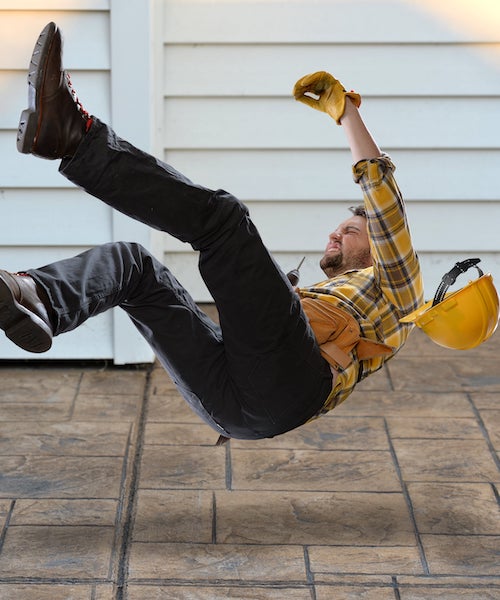
Slip and fall is a term that can describe a range of different accidents where you lose your footing and fall to the ground. These accidents are all similar in that they occur when you are walking or moving about and suddenly end up falling. They can happen to people of all ages.
According to Occupational Health & Safety, slip and fall accidents may cause injuries to various body parts, including the head, arms, legs and back. While many are mild injuries, some may be severe and require intensive medical care and a long time to heal. There are four main types of slip and fall accidents you should know about. This is general information, not legal advice.
The Four Main Types of Slip, Trip and Fall Accidents
How you lose your balance can point to the hazard that caused the fall. For more on the difference, see our comparison of slips, trips and falls.
Slip and fall
The standard type of slip and fall accident, which names the whole group, involves your foot or feet losing traction and slipping on the walking surface. You often fall backward or sideways. Common hazards include wet tile, freshly mopped floors with no warning sign, spilled drinks and leaking coolers. Typical injuries include head injuries, hip fractures, back injuries and broken wrists from trying to catch yourself.
Trip and fall
As the name suggests, a trip and fall is when you catch your foot on something as you walk. Common items include children’s toys and power cords, as well as uneven pavement, loose mats and boxes left in aisles. You usually fall forward, and poor lighting on a property makes these hazards harder to see. Broken wrists and arms, knee, shoulder and facial injuries are common.
Step and fall
A step and fall happens when the height of the surface you are walking on changes. It may be a design change, such as a step down that you did not see, or a hazard, such as a hole. Unmarked steps, broken stairs, dim stairwells and missing handrails are frequent causes, as we explain in our post on stairway accidents. Sprained or broken ankles, torn knee ligaments and hip fractures are typical.
Stump and fall
A stump and fall accident occurs when you stumble over something in your path. It might be the edge of a stair or a flaw in the floor, such as a folded area of a rug or a broken floor tile. Sprains, strains, and knee and back injuries are common. You can be hurt even without a full fall, such as by twisting an ankle while catching yourself.
Slip, trip, step or stump: a quick comparison
These terms overlap, and people often use “slip and fall” to describe all of them. Here is the short version of the difference:
- Slip: Your foot loses grip on a slick surface. You often land backward or on your side.
- Trip: Your foot catches on an object or a raised edge. You usually pitch forward.
- Step: The ground is higher or lower than you expected, such as a missed step or a hole.
- Stump: You stumble on something in your path, like a curled rug or a broken tile. You may twist or strain something without fully falling.
Why does the type of fall matter? The way you fell often points to the hazard, and the hazard points to who was responsible for it. A slip suggests a wet or slick floor. A trip suggests something left in the walkway or a defect in the pavement. A step and fall may point to a design problem or a missing handrail.
When you see a doctor or talk with a lawyer, describe exactly how your feet moved and how you landed. Those details help connect your injuries to the condition of the property.
Common Slip and Fall Injuries
A fall can seem minor in the moment and turn out to be serious. The injury often depends on how you landed and what you hit on the way down. Common slip and fall injuries include:
- Head injuries: Striking your head on a hard floor, counter or curb can cause a concussion or a traumatic brain injury. Headaches, confusion, dizziness or memory trouble after a fall should be checked right away.
- Hip fractures: Falling sideways onto a hard surface puts heavy force on the hip. These breaks can require surgery and a long recovery, especially for older adults.
- Wrist, arm and shoulder injuries: Reaching out to catch yourself is a natural reflex. It often causes broken wrists, fractured elbows and torn shoulder tissue.
- Back and neck injuries: Landing on your back or twisting as you go down can injure discs and muscles and, in serious cases, the spinal cord.
- Knee and ankle injuries: Step and stump falls commonly cause sprains, breaks and torn ligaments.
- Cuts and bruises: Broken glass, sharp edges and rough pavement can cause wounds that need stitches or leave scars.
Some injuries do not show up right away. Pain in your back or neck can build over the next few days, and the signs of a head injury are easy to miss. That is one reason to get checked promptly and keep every record. Some injuries, such as soft tissue damage, can be hard to prove without good medical documentation.
The harm is not always physical. Some people feel anxious walking on certain floors or stairs after a fall. Learn more about whether you can get PTSD from a slip and fall.
Where These Falls Often Happen in Florida
Falls can happen anywhere, but these Florida settings come up often:
- Grocery stores: spills, dropped produce and wet entryways after storms.
- Hotels and resorts: slick lobby tile, wet bathrooms and outdoor stairs.
- Apartment complexes: broken stairs, missing handrails and dark breezeways. See whether your landlord must keep you safe.
- Parking lots: potholes, wheel stops, uneven pavement and poor lighting at night.
- Pool decks: constantly wet surfaces and standing water. Learn how people are often hurt around pools.
Who Is Liable Under Florida Premises Liability Law
Florida law generally requires property owners to keep their property reasonably safe and warn visitors about known hazards. If you are considering a premises liability claim, these issues usually matter.
Your status as a visitor
The duty owed depends on why you were there. An invitee, such as a shopper or hotel guest, is generally owed the highest duty. A licensee, on the property with permission for their own purposes, is generally owed less. A trespasser is generally owed the least, though things can differ when children are involved. These categories are not always clear-cut, so it helps to talk it through with a lawyer.
The transitory foreign substance rule
For falls at businesses, Florida has a specific law: Fla. Stat. § 768.0755. It covers slips on a “transitory foreign substance,” meaning something on the floor that is not supposed to be there, such as water, oil or grease. The injured person must prove the business had actual or constructive knowledge of the dangerous condition and should have taken action to fix it.
The notice requirement
Actual knowledge means the business knew, for example because an employee saw the spill. Constructive knowledge means it should have known, because the hazard was there long enough that employees should have found it, or because the condition happened regularly and was foreseeable. Video, cleaning logs and witness accounts can help show how long a hazard was there.
Falls at homes, apartments and public property
The transitory foreign substance law covers falls at business establishments. If you fell somewhere else, other rules may apply.
A fall at a private home, a rental property or an apartment complex is generally judged under Florida’s broader premises liability principles. Those look at your status as a visitor and whether the owner or manager knew or should have known about the hazard. Landlords may also have duties for shared areas such as stairways, walkways and parking areas.
Falls on property owned by a city, a county or the State of Florida, such as a public sidewalk or a government building, can involve special notice steps before a lawsuit can be filed. Those steps are easy to miss, so talk with a lawyer early if you fell on public property.
Arguments property owners and insurers often raise
Even when a hazard is clear in a photo, the property owner or its insurer may push back. Common arguments include:
- “We didn’t know about it.” The business may say the spill had just happened and no employee could have found it. Video, cleaning logs and witness accounts can help answer this.
- “It was open and obvious.” The owner may argue you should have seen the hazard. Even so, an owner can still have a duty to keep the property reasonably safe.
- “There was a warning sign.” A sign does not automatically end the question. Where it was placed and whether you could see it can matter.
- “You weren’t paying attention.” Claims about your phone, your shoes or how fast you were walking are used to shift part of the blame to you. Under Florida’s comparative negligence rules, shared fault can reduce what you recover.
- “Your injury came from something else.” Insurers may point to an old injury or a gap in treatment. Prompt medical care and consistent records help.
These arguments are one reason to avoid giving a recorded statement before you understand your injuries and your rights. An adjuster may be friendly, but they work for the insurance company, not for you.
What to Do After a Fall
- Report it. Tell the owner or manager and ask for an incident report.
- Photograph the hazard. Capture the spot, the spill or defect, the lighting, any warning signs and your injuries.
- Get witness names. Collect names and phone numbers before people leave.
- Seek care. See a doctor promptly, even if you feel fine, and keep your records.
- Keep the shoes and clothing. Set them aside without washing or wearing them.
- Call a lawyer. Before giving a recorded statement to an insurer, talk with a Florida slip and fall attorney.
Read more in our guide on what to do after a slip and fall accident.
How Gerber Law Looks Into a Fall
A fall case usually comes down to three questions: what the hazard was, how long it was there, and whether the owner knew or should have known about it. When you call us, our team can help:
- Gather photos, witness statements and accident reports
- Examine the property where you fell for wet floors, poor lighting and other dangerous conditions
- Review maintenance logs to see whether the owner neglected basic safety measures
- Look into past incidents at the same property to see if there is a pattern
Surveillance video and cleaning records can be lost or written over, so it helps to reach out soon after a fall.
You will always work directly with your lawyer. Founder attorney Maria Gerber is an accident victim herself, so she understands how painful and disruptive a fall can be. We help injured people across Southwest Florida, including Sarasota, Charlotte and Manatee counties, as well as throughout the state.
Founded in 1999, Gerber Law serves injured people on Florida’s Southwest coast from offices in Sarasota and Venice. Founder Maria Gerber, a former State Prosecutor, never represents insurance companies. We are available 24/7 for free consultations, offer home and hospital visits, and charge no fees or costs unless we win. Call (941) 484-2700.
FAQs
How long do I have to file a slip and fall claim in Florida?
For negligence claims arising after March 24, 2023, Florida generally allows two years to file a lawsuit under Fla. Stat. § 95.11. Some situations have different rules, so talk with a lawyer early, before evidence like video is lost.
What if I was partly at fault?
You may still recover. Under Florida’s modified comparative negligence rule, your compensation is reduced by your share of fault if you are 50% or less at fault. If you are more than 50% at fault, you generally cannot recover.
How much is a slip and fall case worth?
It depends on factors like injury severity, medical bills, lost income, the strength of the evidence and shared fault. We explain these in our article on Florida slip and fall settlement amounts.