When someone walks into Gerber Law Group after a truck accident, the conversation rarely begins with legal terminology. Victims often have questions about what just happened and how things spiraled so quickly. Sooner or later, the emotional shock settles, and a practical concern rises to the surface – what evidence do I need after a truck accident?
Truck accident evidence requirements are more involved than those in a typical passenger vehicle case. Commercial drivers operate under federal safety regulations. Companies are required to keep maintenance logs. Electronic tracking systems record driving activity. That means there is often valuable documentation available, but only if it is preserved correctly and quickly. If evidence disappears, the case becomes harder. If it is secured early, the position becomes stronger.
Why Documentation Is Important
Insurance companies evaluate them based on records. In a truck crash case, the other side may include a corporate trucking company and an insurer with significant resources. Their job is to limit financial exposure. They examine every detail, look for inconsistencies, and find missing proof.
A successful claim must establish how the crash happened, who was legally responsible, and how the injuries affected the injured person’s life. Leaving any of those questions unanswered creates space for doubt.
Proof needed for truck accident claims must connect the driver’s actions or the company’s failures directly to the collision. It must also tie the collision clearly to the injuries and financial losses. Not only do you have to prove that they did something wrong, but also that the wrongdoing or negligence had a direct impact on the claimant.
If a driver were fatigued, there should be records. If brakes failed because of poor maintenance, documentation should show it. If unrealistic scheduling practices pressured drivers to push beyond safe limits, that should be supported with evidence.
The Accident Report Is Not The Full Picture
Law enforcement typically responds to serious truck accidents. Officers document vehicle positions, road conditions, and statements from those involved. If traffic citations are issued, that becomes part of the official record.
The accident report is important; however, it is not the entire story. Officers do not review internal corporate safety policies at the roadside. They do not download hours of service logs or inspect months of maintenance history. They are working in real-time, often in stressful conditions, and their role is to document what is immediately visible.
At Gerber Law Group, we obtain the police report early in the process because it anchors the timeline, and then we expand the investigation beyond it. In many truck cases, the most significant evidence exists outside that first document, buried in records and data that require deliberate follow-up to uncover.
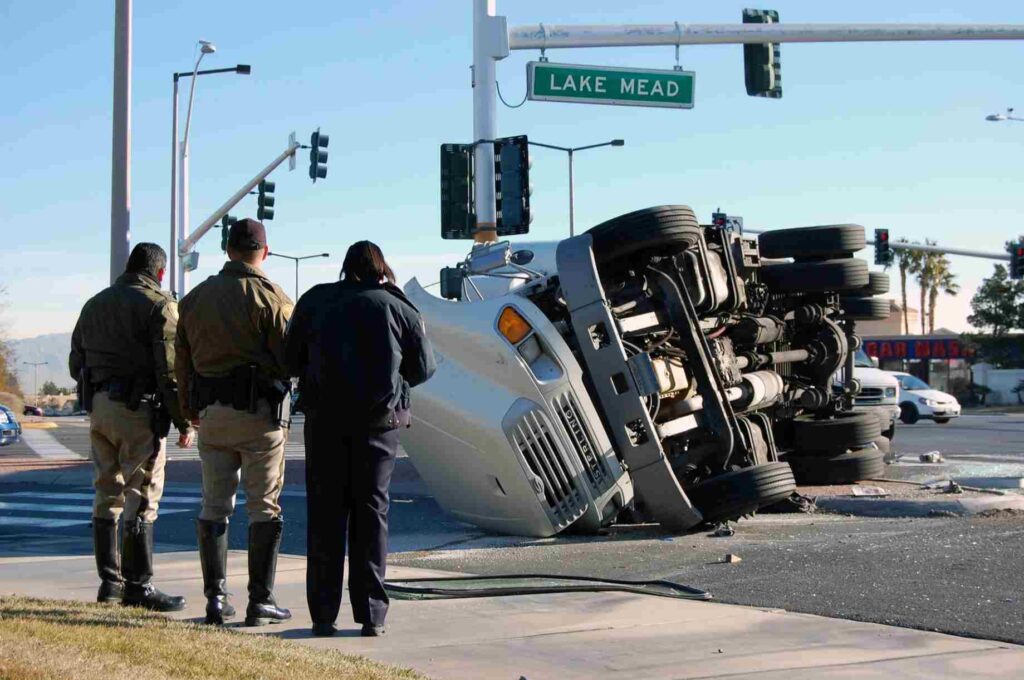
What The Crash Scene Can Reveal
The physical location of the collision often holds information that disappears quickly. The skid marks can indicate braking attempts, and the damage patterns may suggest the angle of impact. Similarly, the debris spread across lanes can show the direction of force.
Photos taken immediately after the accident preserve these details. Even phone images can make a difference months later. Nearby businesses sometimes capture the collision on surveillance cameras. Traffic cameras may record the moments leading up to impact.
Those recordings do not remain available forever. Many systems overwrite footage within days. Gathering evidence after a truck crash requires urgency because electronic data and video can vanish without notice.
In serious cases, accident reconstruction professionals may analyze physical evidence, vehicle damage, and roadway markings to determine how the crash unfolded. The scene tells a story, but only if someone takes the time to listen carefully.
Witness Statements
Witness statements are a crucial form of evidence in a truck accident case because they provide firsthand accounts from people who watched the events unfold. A bystander may have noticed erratic driving, a missed traffic signal, or the exact sequence of impacts. These outside perspectives can confirm the actions of the drivers involved and reveal contributing factors that neither driver is in a position to describe objectively. Securing witness statements promptly is essential, since memories fade and details become less accurate as weeks pass.
When it is safe to do so, ask witnesses at the scene for their contact information and a brief description of what they saw. Recording a short statement on a phone or taking detailed notes preserves their account while it is fresh. Witnesses can later provide written or recorded statements that support the claim, and an attorney can follow up to obtain formal testimony. Multiple corroborating accounts strengthen a case by presenting a consistent, credible version of events that reinforces the physical evidence.
Photographic And Video Documentation
Photographs and video give a truck accident claim an objective visual record that does not fade or change its story. Beyond the crash scene itself, images can document road conditions, weather, skid marks, traffic signals, and signage that may have contributed to the collision, along with vehicle positions and any visible injuries. Details that seem minor in the moment often become important once the insurance company begins disputing how the crash happened.
This visual narrative corroborates witness statements and the police report, and it gives accident reconstruction professionals the raw material they need to establish the sequence of events. Video can be especially powerful. Traffic cameras, nearby business security footage, and dashcam recordings capture the collision as it happened, leaving far less room for competing interpretations of what actually happened.
Vehicle Damage Analysis
The vehicles themselves tell part of the story. The force and angle of a collision leave damage patterns that experts can analyze to reconstruct the crash and determine fault. Detailed photographs and professional assessments of the damage can show whether the impact is consistent with the accounts given by the parties involved, or whether a version of events does not match the physical evidence.
Damage analysis works hand in hand with the truck’s maintenance records. Comparing the condition of the vehicle against its documented history of inspections and repairs can uncover whether mechanical failure caused by neglect played a role in the crash. Identifying those safety violations strengthens a claim and helps ensure that every responsible party, not just the driver, is held accountable.
Driver Records And Electronic Tracking Systems
Commercial truck drivers operate under strict hours of service regulations designed to prevent fatigue. They limit how long a driver can remain behind the wheel before mandatory rest. Fatigue is a common cause of truck accidents, and that is one of the reasons why the trucking industry has such strict regulations regarding driving time.
Most modern commercial trucks are equipped with electronic logging devices that track driving time. Many also contain event data recorders that capture technical information, such as speed and braking activity, before impact. If a driver exceeded legal driving limits or was traveling at an unsafe speed, electronic data can confirm it.
Truck accident evidence requirements often include these digital records because fatigue and speed frequently play roles in serious collisions.
Our skilled legal team can send early preservation letters to prevent the deletion or alteration of this information. Trucking companies control much of the data generated by their vehicles. Securing it promptly protects the integrity of the case.
Maintenance History And Company Oversight
Responsibility in a truck accident does not always stop with the driver. Trucking companies are required to inspect and maintain their fleets on a regular basis. Brake systems, tires, steering components, and lighting must meet safety standards. Records of these inspections and repairs are supposed to be kept.
Maintenance logs can reveal whether known mechanical problems were ignored. A pattern of delayed repairs may suggest negligence at the corporate level.
Employment records also deserve attention. Did the company conduct proper background checks before hiring the driver? Was adequate training provided? Were prior safety violations overlooked?
Sometimes broader operational decisions contribute to unsafe conditions. Unrealistic delivery schedules can encourage drivers to push beyond safe limits. Weak oversight can allow risky behavior to continue. Examining company records is often just as important as reviewing driver conduct.
Medical Documentation
While fault establishes responsibility, medical records establish harm. Emergency room reports document immediate injuries. Imaging studies reveal fractures, disc injuries, or internal trauma. Follow-up appointments record ongoing pain and limitations. Insurance companies frequently attempt to minimize injuries. They may suggest that symptoms are unrelated to the crash or existed beforehand.
Clear and consistent medical documentation counters those arguments. Treatment records connect the injury to the collision and show how it affects daily life.
Lost income must also be documented carefully. Employer statements, pay records, and tax information help establish financial impact. In more serious cases, future medical needs and reduced earning capacity may require expert evaluation because compensation is related to documentation. The clearer the records, the stronger the claim.
Preserving Evidence Before It Disappears
Much of the evidence in a truck accident case has a shelf life. Federal regulations require motor carriers to retain driver records of duty status for only six months, and electronic logging systems can overwrite older data in routine cycles. Security camera footage from nearby businesses is often deleted within days or weeks. Skid marks wash away, vehicles are repaired or salvaged, and the crash scene returns to normal traffic.
This is why the first weeks after a collision matter so much. A preservation letter, sometimes called a spoliation letter, formally notifies the trucking company and its insurer that litigation is anticipated and that logs, electronic data, maintenance records, and the vehicle itself must be preserved. Once that notice is delivered, destroying or losing the evidence can carry serious consequences for the carrier. Sending it early keeps the strongest proof in the case instead of letting it quietly disappear.
What We Advise Clients To Do Right Away
After a truck accident, medical care comes first. Even if injuries seem minor, evaluation is important. Some conditions develop symptoms later. If you are physically able, take photographs of the vehicles and surrounding area. Obtain the truck driver’s information, including the company name and insurance details.
Avoid discussing fault at the scene or giving recorded statements to insurance adjusters before speaking with legal counsel. Understanding truck accident evidence requirements before engaging with insurers can prevent statements that later complicate the claim. Trucking companies often begin their own investigation immediately, so protecting your position early is essential.
How Gerber Law Group Handles These Cases
When someone hires Gerber Law Group after a truck collision, we move quickly but deliberately. We begin by listening. Every crash is unique, and every injury affects daily life differently. Understanding the full impact helps decide the strategy.
From there, we identify potential sources of evidence. Preservation notices are sent where necessary. Driver logs, maintenance records, employment files, and available video footage are requested. In complex cases, accident reconstruction professionals may be consulted.
We build each case as though it may need to go to court, even when resolution through negotiation is possible. Strong preparation strengthens negotiation leverage.
For individuals searching for Sarasota truck accident attorneys who understand both regulatory details and personal realities, our firm is prepared to take on that responsibility. These cases often involve experienced defense teams and substantial insurance coverage. Detailed evidence levels the field.
Returning To The Core Question
Clients often wonder what evidence is needed after a truck accident. The answer includes more than a single document. Police reports, scene photographs, witness statements, electronic driver logs, maintenance histories, employment records, and comprehensive medical documentation all contribute.
No one piece wins the case by itself. Together, they create a clear narrative of responsibility and harm. The companies involved are structured and well-represented. Acting early protects critical documentation and strengthens your ability to pursue fair compensation.
At Gerber Law Group, our role is to guide injured individuals through that process with focus and persistence. Strong cases are built on facts that withstand scrutiny. Our responsibility is to gather those facts, preserve them, and present them effectively on behalf of the people we represent. To learn more, you are welcome to schedule a free consultation with us.